
5 Pillars of Tourism: Complete Guide with India Examples
The 5 Pillars of Tourism: A Complete Guide with India Examples Updated July 2026 — curated by the Idyllic India...
Read More →
Updated July 2026 — curated by the Idyllic India Tours travel team
Dussehra is the day Navratri resolves. After nine nights of worship, the tenth day, known as Vijayadashami, marks a victory: the goddess Durga’s over the demon Mahishasura, and, across much of northern India, Rama’s over the ten-headed king Ravana. The name comes from the Sanskrit dasha-hara, roughly “the removal of ten,” a phrase that gets read either as the ten sins Rama’s victory is said to burn away or simply as a nod to Ravana’s ten heads.
Unlike the nine nights that build up to it, Dussehra behaves like a festival in its own right almost everywhere in India, just not the same festival twice. Delhi and much of the north burn towering effigies at dusk. Mysuru sends an elephant procession through lit streets. A mountain valley in Himachal Pradesh gathers hundreds of village gods for a week-long fair that only starts on this day. This guide sticks to the tenth day itself, what it means, when it falls, and which version of it is worth planning a trip around.
Ask why Dussehra matters and you’ll get two different answers depending on where you ask.
In the south and east, the emphasis falls on the goddess. Durga is said to have fought the shape-shifting demon Mahishasura for nine nights before defeating him on the tenth, and Vijayadashami is her victory day, the moment the divine feminine (shakti) triumphs. In Bengal this is the day Durga Puja closes: married women smear each other with vermilion in the ritual of Sindoor Khela, and the idols are carried out for immersion.
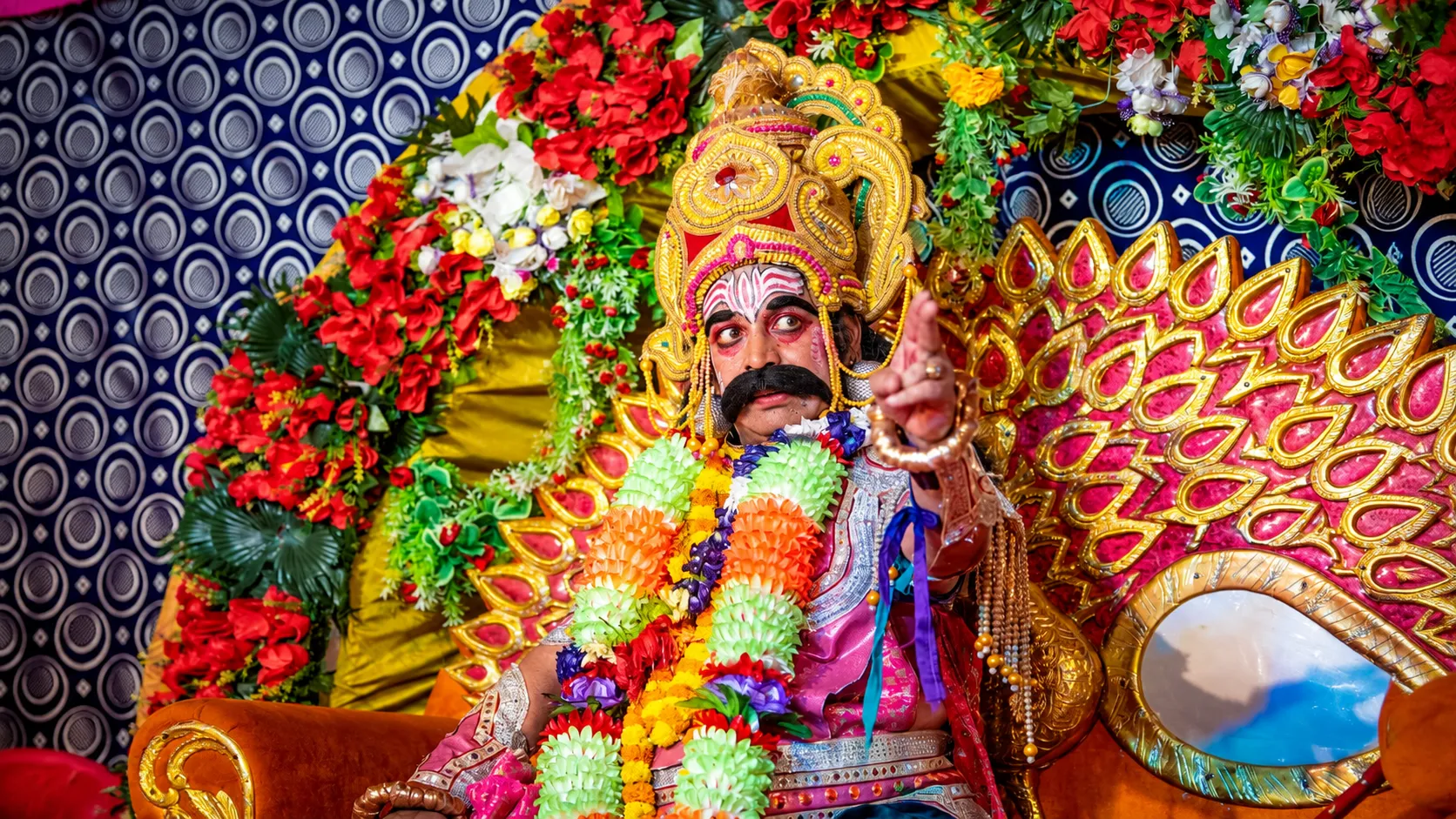
In the north, the story shifts to the Ramayana. Rama, in exile with his wife Sita and brother Lakshmana, wages war on Ravana, the demon king of Lanka who had abducted Sita. Dussehra marks Rama’s victory, staged for weeks beforehand as Ramlila, “Rama’s play,” and settled on the day itself with the burning of Ravana’s effigy.
Neither story cancels the other out. Many households and towns hold both at once, and the throughline is the same regardless of which one is told: dharma outlasting its opposite. If you take away one thing from either version, it’s that Dussehra is a festival about what wins, not about the fighting itself.
Dussehra follows the lunar calendar, so it moves against the Gregorian one from year to year, though it stays within a September–October window tied to the end of Sharad Navratri.
Year | Dussehra (Vijayadashami) | Preceding Navratri |
2026 | Tuesday, 20 October | 11 to 19 October |
2027 | Saturday, 9 October | 30 September to 8 October |
These dates follow the New Delhi panchang; some regional calendars list Dussehra a day earlier or later, so confirm locally before booking travel around it.
One disambiguation worth making: Ganga Dussehra is a separate, unrelated festival. It honours the river Ganges, falls in May or June, and has nothing to do with Ravana, Rama or the goddess. If a search result about “Dussehra” mentions bathing in the Ganges in early summer, it’s describing that festival, not this one.
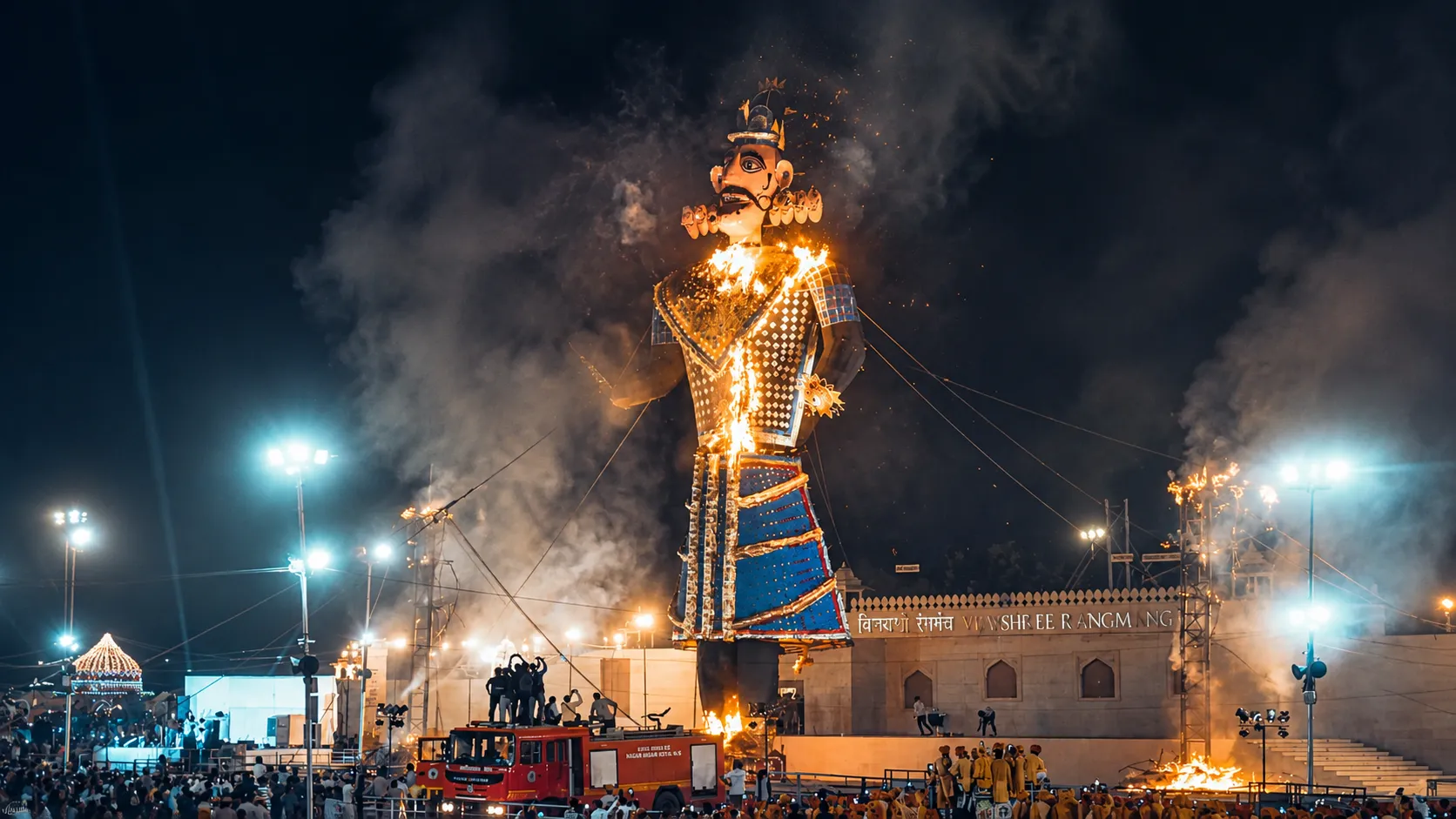
The best-known image of Dussehra is the burning of Ravana. In towns and cities across northern India, effigies of Ravana and, often, his brother Kumbhakarna and son Meghnad are built in the weeks before the festival, usually stuffed with firecrackers, and set alight at dusk on Dussehra evening. The fire is read as the destruction of ego and evil, not of a person, and it’s typically staged as the finale to a Ramlila performance rather than as a standalone event.
The scale varies enormously by city and neighbourhood, from a modest local effigy to organised grounds with fireworks displays. If you’re planning to watch one, arrive well before dusk: crowds build fast, roads around the burning ground usually close to traffic, and the safest viewing is from a fixed spot with some distance from the effigy itself rather than pressed into the moving crowd near it.
If your trip is built specifically around the tenth day rather than the full nine nights of Navratri, these are the clearest options:
Dussehra is a national holiday in India, so expect some offices, markets and services to close for the day, and expect traffic to slow considerably near Ramlila grounds and effigy sites as evening approaches. Book hotels and any ticketed viewing (Mysuru’s procession route in particular) well ahead, since rooms in Mysuru, Kullu and central Delhi fill early. If you’re watching a Ravana Dahan, keep some distance once the fire starts, both for the fireworks packed into the effigy and for the crowd that surges as it falls.
What it means, when it falls, and where to experience the festival across India.
2026 · Tuesday, 20 October | 2027 · Saturday, 9 OctoberDussehra is the tenth day of Navratri, known as Vijayadashami. Its meaning changes across India, but the central theme is victory: Durga over Mahishasura in one tradition, and Rama over Ravana across much of northern India.
There is no single Dussehra experience. Tap a place below to explore what a traveller can expect.
If your trip is built specifically around the tenth day rather than the full nine nights of Navratri, these are the clearest options.
The tenth and final day of Navratri, marking Durga's victory over the demon Mahishasura and, in much of northern India, Rama's victory over the demon king Ravana. It's also called Vijayadashami.
20 October in 2026, and 9 October in 2027. The date shifts each year with the lunar calendar, so check a local panchang closer to your travel dates.
Yes, they're two names for the same day. "Vijayadashami" is the more formal Sanskrit name; "Dussehra" or "Dasara" is the everyday one.
Not quite. Durga Puja is the Bengali festival that runs through the last several days of Navratri. Vijayadashami/Dussehra is its final day, when the idols are immersed.
Yes. According to the Ramayana, Rama's return to Ayodhya after defeating Ravana came twenty days later, which is why Diwali falls about three weeks after Dussehra.
No. Ganga Dussehra honours the river Ganges and falls in May or June. It shares part of the name but nothing else with the Dussehra covered here.
Generally yes, from a fixed vantage point at a sensible distance. The effigies are usually packed with firecrackers, and crowds move quickly once the fire is lit, so arrive early and choose where you'll stand before the crowd builds.
A single evening's Ravana Dahan or Mysuru's procession is easy to miss if the logistics aren't sorted in advance. Idyllic India Tours builds private, tailor-made itineraries around dates like this one.
Plan Your JourneyDates shown follow the New Delhi panchang reference and can differ by a day locally. Confirm locally before booking travel.
A single evening’s event, a Ravana Dahan or Mysuru’s procession, is easy to miss if the logistics aren’t sorted in advance: road closures, sold-out viewing spots, a hotel booked in the wrong part of town. Idyllic India Tours builds private, tailor-made itineraries around dates like this one, whether that means a short stay in Delhi timed to Ramlila and Ravana Dahan, or a longer route built around Mysuru’s Dasara.
The tenth and final day of Navratri, marking Durga’s victory over the demon Mahishasura and, in much of northern India, Rama’s victory over the demon king Ravana. It’s also called Vijayadashami.
20 October in 2026, and 9 October in 2027. The date shifts each year with the lunar calendar, so check a local panchang closer to your travel dates.
Yes, they’re two names for the same day. “Vijayadashami” is the more formal Sanskrit name; “Dussehra” (or “Dasara”) is the everyday one.
Not quite. Durga Puja is the Bengali festival that runs through the last several days of Navratri. Vijayadashami/Dussehra is its final day, when the idols are immersed.
Yes. According to the Ramayana, Rama’s return to Ayodhya after defeating Ravana came twenty days later, which is why Diwali, the festival marking that homecoming, falls about three weeks after Dussehra.
No. Ganga Dussehra honours the river Ganges and falls in May or June. It shares part of the name but nothing else with the Dussehra covered here.

Chat on WhatsApp