
5 Pillars of Tourism: Complete Guide with India Examples
The 5 Pillars of Tourism: A Complete Guide with India Examples Updated July 2026 — curated by the Idyllic India...
Read More →
Updated July 2026 — curated by the Idyllic India Tours travel team
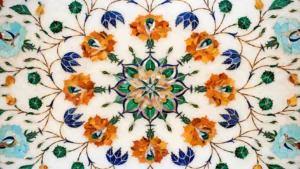
Walk up to the cenotaph screen inside the Taj Mahal and the white marble seems to bloom. Flowers and vines in red, green and blue run across the surface, each petal a tiny piece of cut stone set flush with the marble around it. This technique is what people mean by Agra marble inlay. In India it is called parchin kari, and the craft is still alive in the lanes of Agra, though in far fewer hands than it once was.
This guide explains where Agra marble inlay came from, which stones it uses, how a piece is made, where visitors can see it, and what to look for if you plan to buy something. It is written for travellers adding Agra to a Golden Triangle itinerary, and for anyone curious about the craft beyond the souvenir shelf.
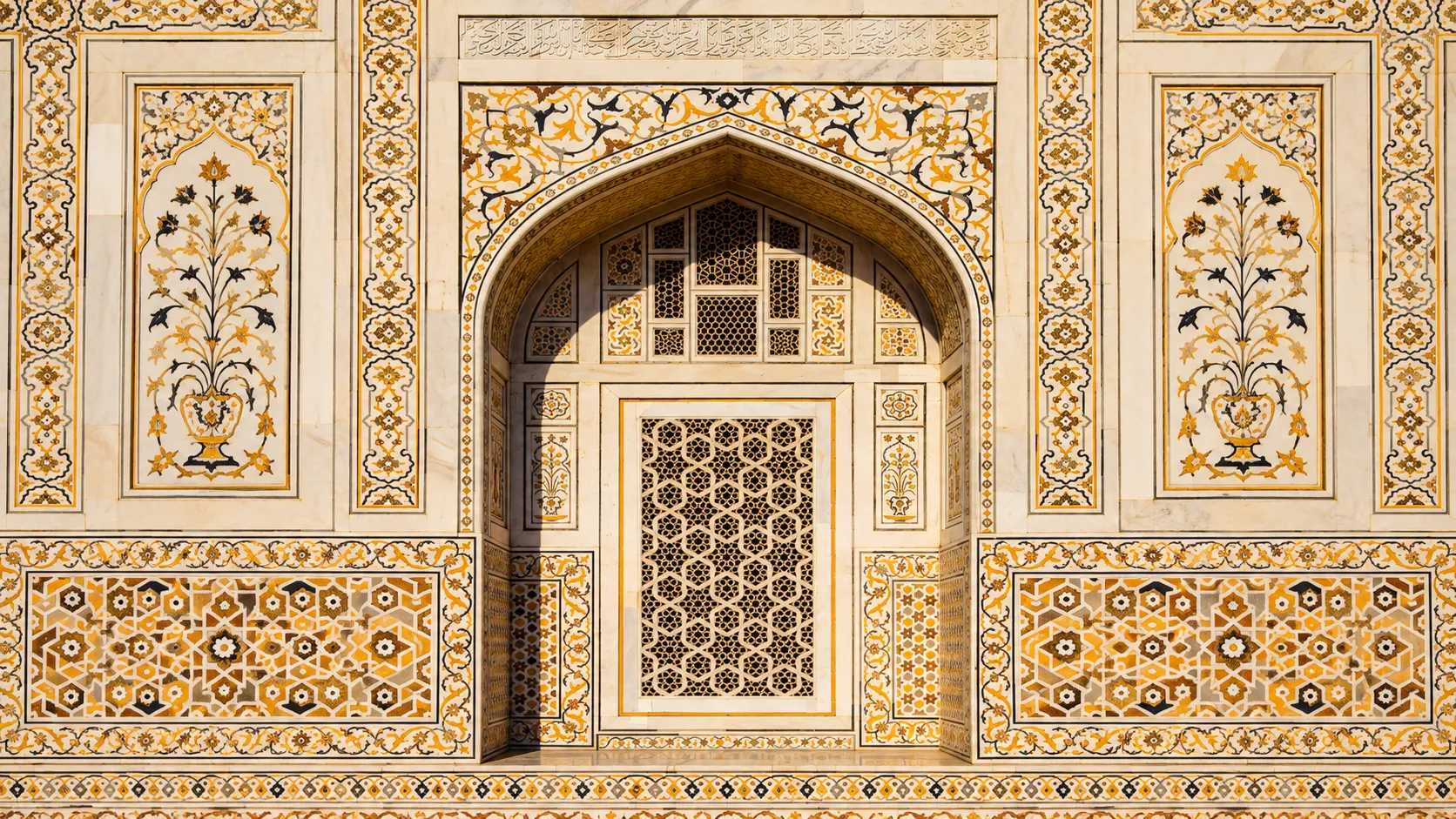
In simple terms, an artisan carves shallow recesses into white marble and fills them with thin, polished pieces of coloured stone, cut so precisely that the joins almost vanish. The work goes by several names. Parchin kari (also written parchinkari, or pachchikari) is the Indian term. Pietra dura, Italian for “hard stone,” is the European one. India’s Handicrafts portal describes the technique as having begun in 16th-century Rome and flourished in Florence, before Mughal patronage brought it to India.
The marble matters as much as the stones. The Handicrafts portal names white Makrana marble as the primary material, valued for being soft enough to carve yet durable. A GIA research article on Taj Mahal gemstones notes that the Taj’s marble came from the Makrana quarries in Rajasthan, nearly 400 km away.
Accounts of how inlay reached India do not fully agree, which is worth knowing before you read a guide that presents a single tidy story.
The safest reading is that inlay developed in India under successive Mughal rulers, with ideas and skills arriving from several directions. What is clearer is the sequence of monuments. Live History India dates Itmad-ud-Daula’s tomb in Agra to 1621–1627 and calls it the first Mughal structure built entirely of white marble, with inlay in mother-of-pearl, jasper and carnelian. The Taj Mahal followed: construction began in 1632 and the whole complex was finished in 1653, according to GIA.
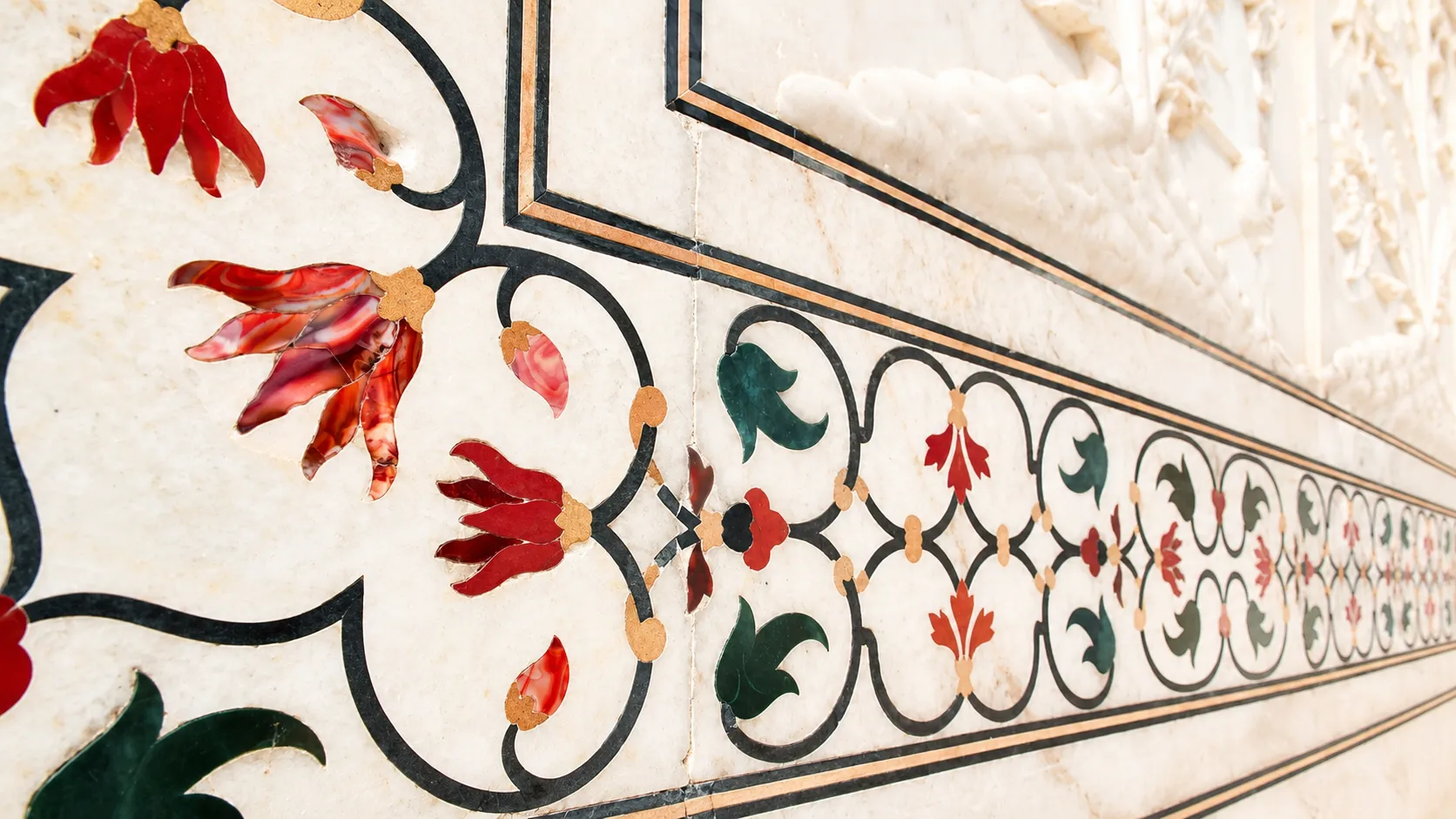
Part of the fascination of Mughal inlay is where the materials came from. The GIA article reports that over 40 different gem materials are documented in the literature on Taj Mahal inlay. It lists several sources, drawn from older records:
| Material | Reported source |
|---|---|
| Lapis lazuli | Afghanistan |
| Turquoise | Persia (Iran) |
| Nephrite jade | China (Khotan and Kashgar) |
| Agate, rock crystal | Deccan, India (agate); Sri Lanka and Pegu also named for crystal |
| Black onyx | Used for the Quranic inscriptions, carved to fit the letterforms |
| Marble | Makrana quarries, Rajasthan |
GIA adds that malachite and turquoise appear only in modern parchin kari made near the Taj, a reminder that today’s workshops do not use identical materials. Live History India also notes that stones were chosen for colour and symbolism, such as carnelian for fulfilling desires and lapis lazuli for protection, though that reading comes from a single article and is better treated as tradition than documented rule.
Workshops differ, and the Taj-era method was not identical to the modern one, but the sequence below combines the steps described by India’s Handicrafts portal, GIA and Outlook Traveller.
A single leaf or petal is often built from several small pieces of different stones, which is how the shading in the best work is achieved.
According to the Handicrafts portal, the motifs are geometric, floral and arabesque, frequently combined with Islamic calligraphy. Islamic art generally avoids figural depictions, so you will not see people or animals in classic work. The same source says geometric designs are read as symbols of infinity, while floral designs reflect the Mughal idea of paradise. Live History India calls the arabesque, a stylised floral form with interlocking geometry, the most common motif.
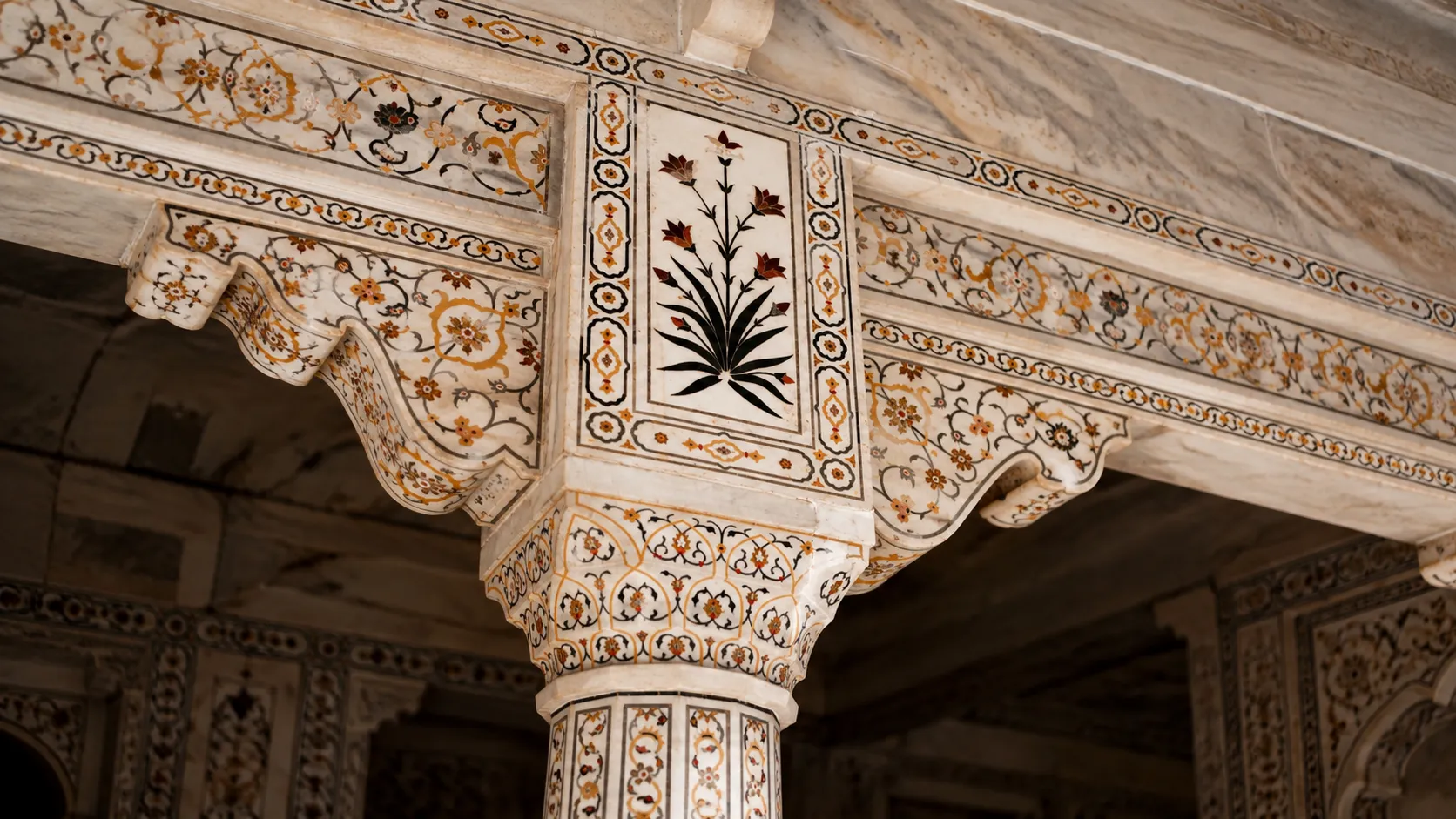
Check current opening hours, closing days and ticket prices for the monuments on the Archaeological Survey of India’s official channels, as these change.
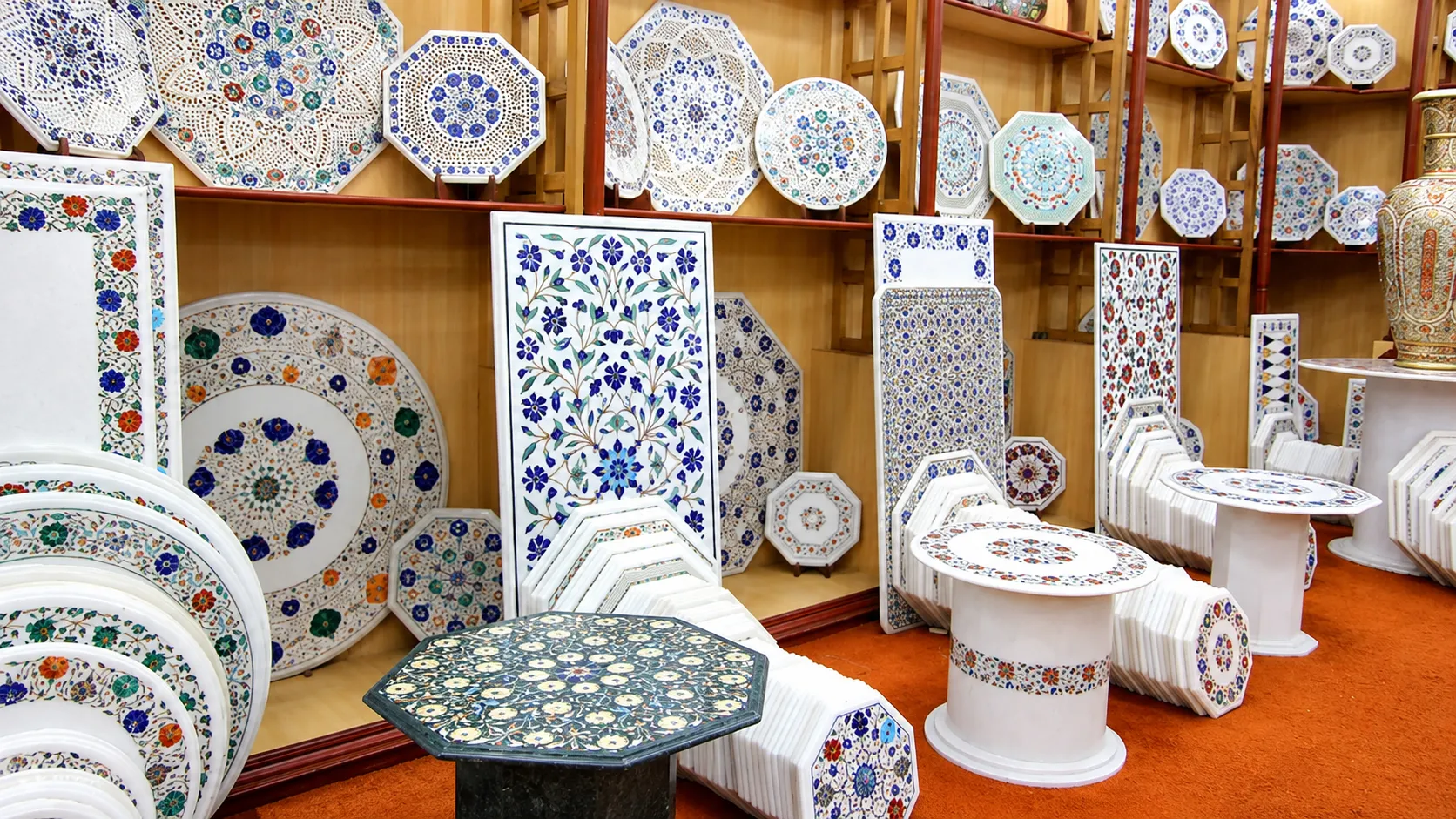
Outlook Traveller reports that after the British took Agra, travellers wanted souvenirs, which created a market for inlay and, eventually, an industry. Live History India adds that after Mughal power declined in the 18th century, artisans began making objects such as tabletops and jewellery boxes for European buyers. The Handicrafts portal lists today’s products as tables, photo frames, vases, trays, plates, tiles, chess boards and jewellery boxes.
That change shows in the craft’s economics. Live History India says only a handful of families still carry on the tradition and that many young artisans have left it, without giving a precise count. Buying a well-made piece from an identifiable workshop is one of the few direct ways a visitor can support that continuity.
The checks below are general trade guidance rather than anything specific to one shop. Treat them as questions to ask, not as a guarantee.
Most visitors meet Agra as part of the Delhi–Agra–Jaipur circuit. Idyllic India Tours’ Golden Triangle tours cover that route, while the dedicated Taj Mahal tour focuses on Agra itself. For a wider look at the city, the guide to the top places to visit in Agra is a useful companion. If a craft focus matters to you, send an enquiry about a private, customised itinerary and ask whether an inlay workshop visit can be included; availability would need to be confirmed with the team.
Agra marble inlay is a craft where the reading of the stone, the steadiness of the hand and the patience of the setting all show in the final surface. Looking closely at the Taj Mahal’s flowers, then at a small modern piece in a workshop, makes the connection plain. Ask what the stones are, check how flush the joins sit, and buy from someone who can tell you who made the piece.
Build your own parchin kari tile the way Agra’s craftsmen do: one cut stone at a time, then scrub, buff and inspect.
Part of the fascination of Mughal inlay is where the materials came from. Match each material to its reported source. Wrong guess? Try again.
Questions 1 to 4 reflect general trade guidance on judging a piece, not a guarantee. Question 5 comes from GIA.
They are closely related. Pietra dura is the Italian name for inlaying cut hard stones into stone, and parchin kari is the Indian name for the Mughal-era craft. Many sources use the terms interchangeably, though the designs differ, with Mughal work favouring floral, arabesque and geometric patterns.
Sources describe the inlay as semi-precious stones, including lapis lazuli, carnelian, jade and black onyx. GIA’s review reports over 40 gem materials in the literature. The specific list is a matter of ongoing scholarship.
White Makrana marble from Rajasthan is the traditional choice, according to India’s Handicrafts portal and GIA.
Yes, in the lanes of Agra and around Fatehpur Sikri, though Live History India reports that only a handful of families continue the tradition.
Chat on WhatsApp