Sarnath: An Idyllic Pilgrimage to India's Newest UNESCO World Heritage Site
Updated July 2026 — curated by the Idyllic India Tours travel team
- July 31, 2026
- 5:15 pm
Built in 1910, this is the oldest site museum run by the Archaeological Survey of India and the permanent home of the original Lion Capital, along with Mauryan and Gupta-era Buddhist sculpture recovered from the excavations.
The Dhamek Stupa, Sarnath — the exact spot where the Buddha delivered his first sermon, now inscribed on the UNESCO World Heritage List.
There is a particular kind of quiet at Sarnath. Even with visitors moving along its brick paths and monks murmuring prayers beneath the trees, the deer park where the Buddha once sat down among five wandering ascetics still feels like a place built for stillness. On 25 July 2026, the world made that stillness official: the Ancient Buddhist Site of Sarnath was inscribed on the UNESCO World Heritage List, becoming India’s 45th World Heritage Site and the fourth in Uttar Pradesh, after the Taj Mahal, Agra Fort, and Fatehpur Sikri.
For a site that has drawn pilgrims for roughly 2,500 years, the recognition is less a discovery than a long-overdue formality. Here is everything worth knowing about Sarnath — its history, what earned it UNESCO status, and how to actually plan a visit — before you go.
Sarnath Joins the UNESCO World Heritage List
The inscription was confirmed during the 48th session of the World Heritage Committee, held in Busan, South Korea, in July 2026. Sarnath had sat on India’s UNESCO Tentative List since 1998 — a 28-year wait that finally ended this summer. UNESCO officials described the site as a living testament to over two and a half millennia of continuous Buddhist pilgrimage, still active and still revered today rather than preserved only as a ruin.
The listing covers two connected components under the name “Ancient Buddhist Site, Sarnath”: the archaeological remains at the heart of the deer park, including the Dhamek and Dharmarajika Stupas, and the separately located Chaukhandi Stupa, which marks a different chapter of the same story.
Why Sarnath Earned Its Place Among the World's Treasures
To understand why this patch of ground outside Varanasi matters so much, it helps to go back to the story itself.
After attaining enlightenment at Bodh Gaya, Siddhartha Gautama walked roughly 250 kilometres to Sarnath — then known as Isipatana, or Rishipatana, and dotted with the mrigadava, or deer park, that gives the site its enduring nickname. There, he found the five ascetics who had once been his companions and delivered his first teaching: the Dhammacakkappavattana Sutta, or “Setting in Motion the Wheel of Dharma.” That sermon laid out the Four Noble Truths and the Eightfold Path, and with it, the first five monks of the Buddhist sangha came into being. Buddhism, as a living tradition, effectively began right here.
That single afternoon is why Sarnath ranks alongside Lumbini (birth), Bodh Gaya (enlightenment), and Kushinagar (parinirvana) as one of Buddhism’s four most sacred pilgrimage sites — and why emperors, monks, and travellers have kept returning to it for two and a half thousand years since.
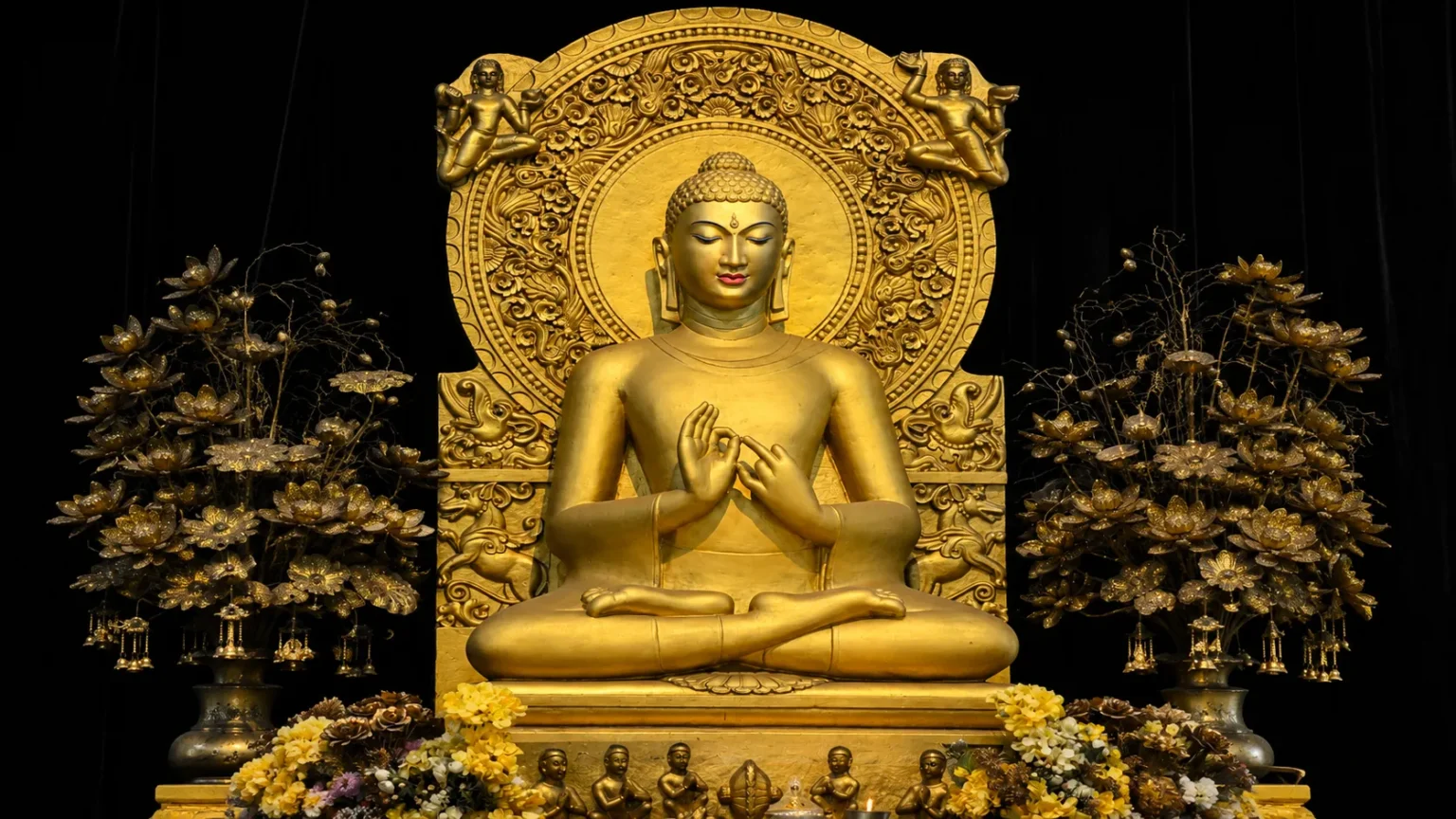
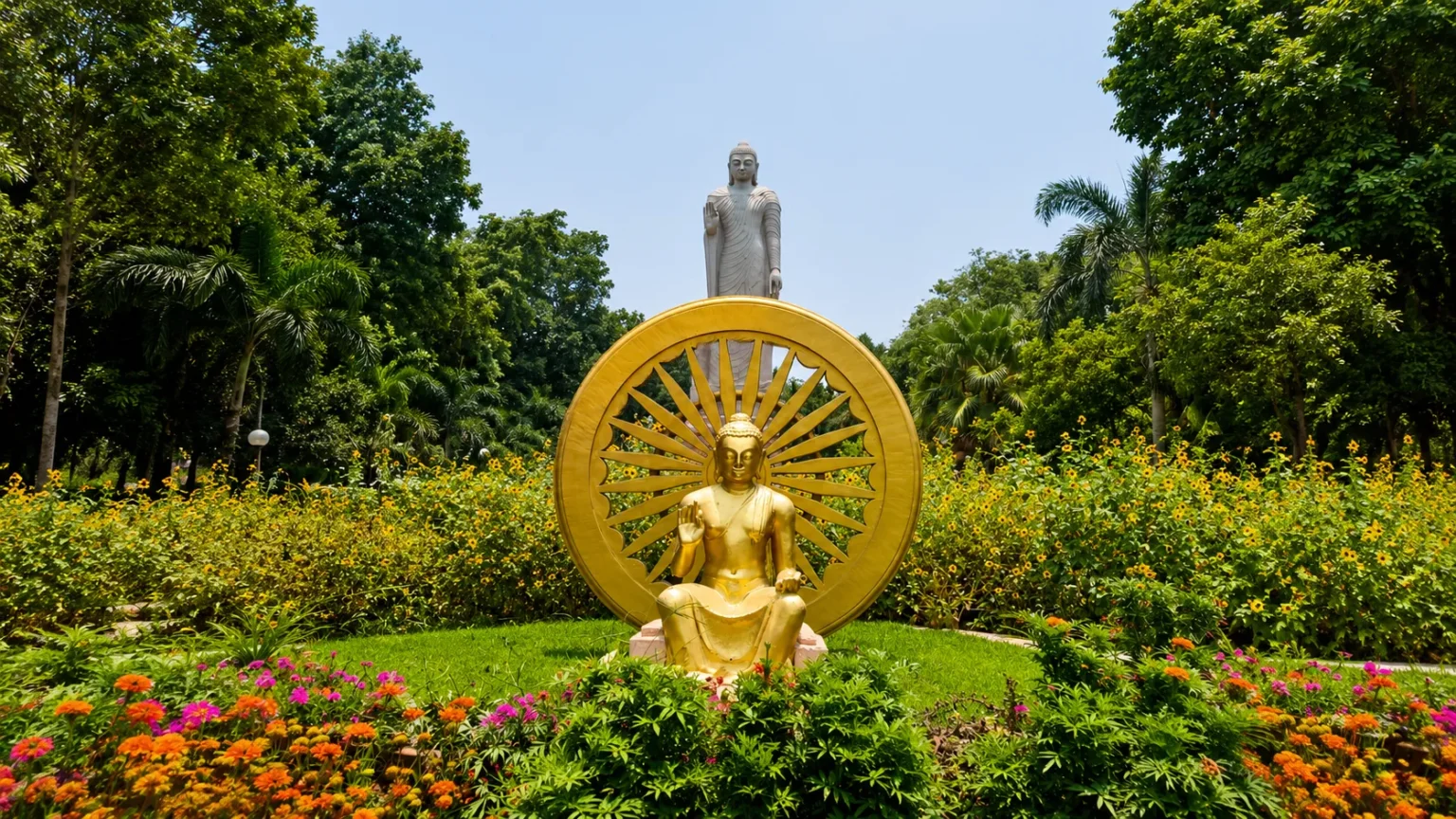
A golden image of the Buddha in the teaching gesture (dharmachakra mudra) before the Wheel of Dharma at Sarnath — a modern echo of the first sermon delivered on this ground.
Monument by Monument: What's Actually Protected
Sarnath isn’t a single building — it’s a landscape of ruins, relics, and living temples layered across centuries. Here’s what makes up the UNESCO-listed site and the wider complex around it.
1. Chaukhandi Stupa
The first monument most visitors encounter, standing slightly apart from the main park. It marks the spot where the Buddha is believed to have met his five former companions before entering the deer park. The mound beneath is ancient, but the octagonal tower on top was added in the 16th century to commemorate a visit by the Mughal emperor Humayun — making it a rare structure where Buddhist and Mughal history sit stacked on top of each other.
2. Dhamek Stupa
The most recognisable structure at Sarnath and the literal centrepiece of the UNESCO listing. This cylindrical tower of brick and carved stone rises 43.6 metres — about 143 feet — and marks the exact spot where the first sermon was delivered. Emperor Ashoka commissioned the original structure around 249 BCE; the stupa seen today largely dates to reconstruction during the Gupta period in the 5th–6th century CE, its lower band still carved with delicate geometric and floral patterns.
3. Dharmarajika Stupa
Now reduced mostly to its foundation, this stupa was historically significant as a relic shrine. Its remains, excavated in the 18th and 19th centuries, form part of the protected archaeological zone alongside the Dhamek Stupa.
4. Ashoka Pillar and the Lion Capital
Erected around 250 BCE, the polished sandstone pillar once stood over 15 metres tall, inscribed with edicts urging unity within the Buddhist community. Broken during medieval invasions, its shaft remains near the Dhamek Stupa. But its crowning glory — the Lion Capital, four addorsed lions atop a wheel of dharma — has a legacy that reaches into the present: it was adopted as independent India’s national emblem, its motto Satyameva Jayate (Truth Alone Triumphs) drawn from the Mundaka Upanishad, and the 24-spoke wheel beneath the lions now sits at the centre of the Indian national flag.
5. Sarnath Museum
Built in 1910, this is the oldest site museum run by the Archaeological Survey of India and the permanent home of the original Lion Capital, along with Mauryan and Gupta-era Buddhist sculpture recovered from the excavations.
6. Mulagandha Kuti Vihar
A modern temple, built in 1931 by the Mahabodhi Society, standing on ground believed to be close to the Buddha’s original meditation hut. Its interior walls are covered in murals depicting scenes from the Buddha’s life, painted by Japanese artist Kosetsu Nosu.
7. International monasteries
Beyond the archaeological core, Sarnath has grown into something like a living map of the Buddhist world — Thai, Tibetan, Sri Lankan, Japanese, Chinese, and Burmese monasteries have all built temples here over the past century, each bringing its own architectural style to the deer park’s edges.
We’ve mapped the whole site below — tap through each point to see what you’ll actually find there.
Explore the site
The Sacred Landscape of Sarnath
Eight points around the Wheel of Dharma. Tap each one to see what you'll find there — and why it matters.
Wheel of
Dharma
Dharma
Based on the ASI-protected core of the UNESCO-inscribed site, plus the wider living complex around it.
Inside one of Sarnath’s shrine halls — the site remains an active place of worship, not only an archaeological monument.
Planning Your Visit: Timings, Entry & Getting There
Sarnath sits about 10 kilometres northeast of Varanasi — roughly a 25–30 minute drive by taxi or auto-rickshaw, making it an easy half-day addition to any Varanasi itinerary.
Site timings: The archaeological park is open daily, 6:00 AM to 6:00 PM. Museum timings: 9:00 AM to 5:00 PM, closed every Friday. Entry fee: A nominal fee applies for Indian and SAARC nationals, with a higher fee for other foreign nationals; a combined ticket typically covers both the park and museum. The Archaeological Survey of India revises rates periodically, and a fresh UNESCO listing often brings updated ticketing arrangements, so it’s worth confirming the current fee on the ASI Sarnath Museum website shortly before you travel. Suggested duration: 3–4 hours covers the archaeological park, the museum, and Mulagandha Kuti Vihar at an unhurried pace. What to bring: A valid photo ID, comfortable walking shoes, and modest clothing that covers shoulders and knees — this remains an active place of worship, not just a ruin.
Best Time to Visit Sarnath
October to March brings the most comfortable weather for exploring the open, largely unshaded grounds, with daytime temperatures generally in a pleasant range. April through June turns punishingly hot, and the July–August monsoon brings heavy, unpredictable rain.
One date is worth building a trip around deliberately: Buddha Purnima, usually falling in May, marks the Buddha’s birth, enlightenment, and death all on the same day and draws Buddhist pilgrims from across the world to Sarnath for special ceremonies. It’s a remarkable time to visit, though also the busiest — plan transport and accommodation well ahead if you’re travelling then.
For a fuller picture of when to visit different parts of the country, our month-by-month guide to the best time to visit India breaks down weather and festivals region by region.
Traveller Tips
- Go early. The park opens at 6 AM, and the soft morning light on the Dhamek Stupa — before the day’s heat and crowds arrive — is worth the early start.
- Dress and behave respectfully. Monks pray and meditate here daily. Keep voices low near the stupas and monasteries, and remove footwear before entering Mulagandha Kuti Vihar and the other temples.
- Pair it with Varanasi. Most visitors combine a morning at Sarnath with an afternoon at the Kashi Vishwanath Temple and an evening Ganga Aarti at the ghats — a full, contrasting day of Buddhist stillness and Varanasi’s living intensity.
- Hire a guide for context. The ruins reward interpretation — a good guide can point out details in the stone carving and excavation history that are easy to miss on your own.
- It’s an easy, welcoming stop for solo travellers. The park is open, well-populated with visitors and monks throughout the day, and doesn’t require navigating crowds the way some of Varanasi’s older lanes do — a gentler introduction if you’re travelling solo.
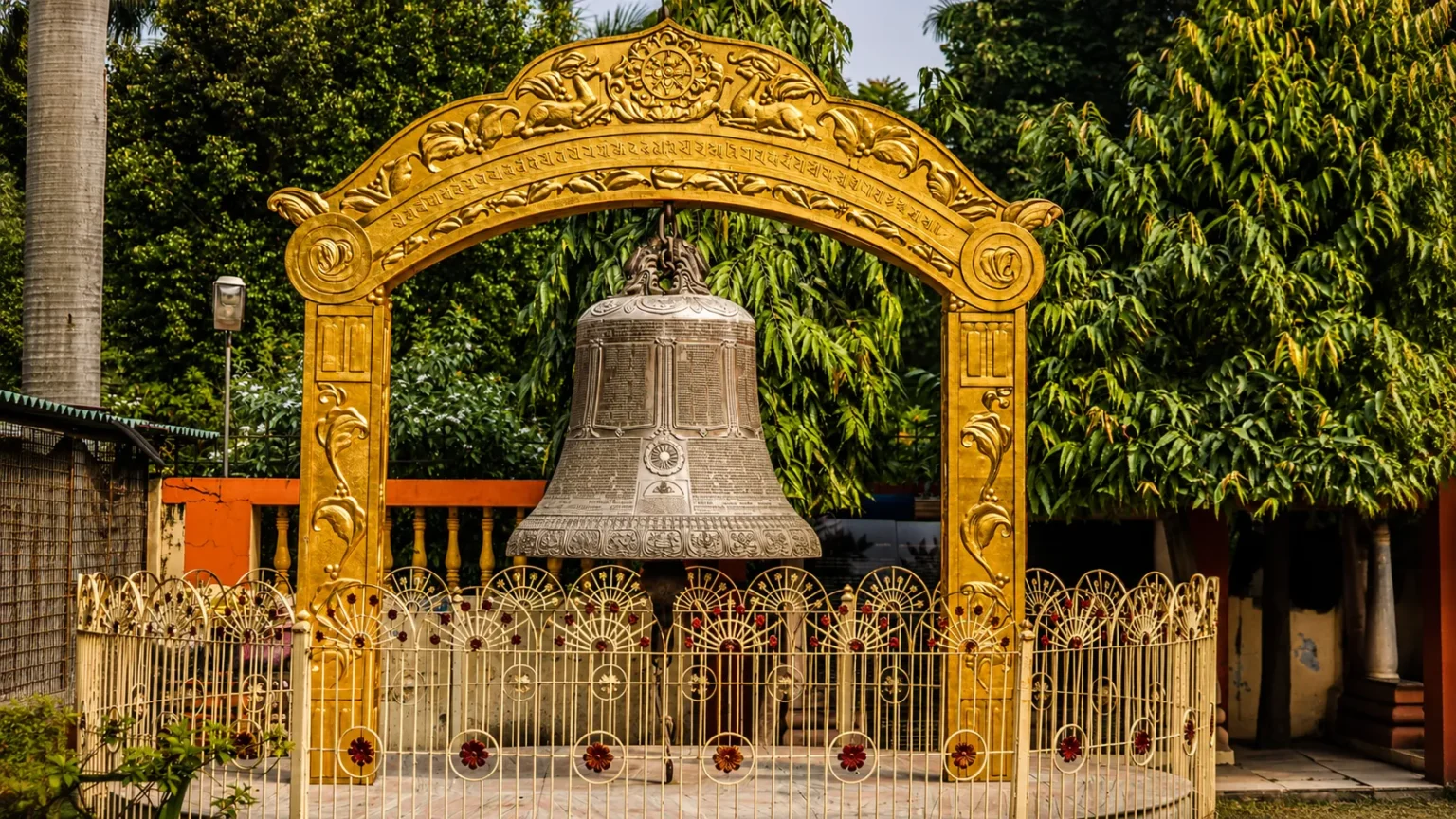
A ceremonial bell at one of Sarnath’s monasteries, framed by the deer-and-wheel motif that has symbolised this site since antiquity.
Experience Sarnath With Idyllic India Tours
Sarnath already forms part of our Golden Triangle with Varanasi journey, which pairs Delhi, Agra, and Jaipur with the spiritual depth of Varanasi and this newly-inscribed World Heritage Site. If you’re staying on in Varanasi, our guide to the best luxury hotels in Varanasi covers where to base yourself for easy access to both the ghats and Sarnath.
Travelling further along the Ganges? Our Ramayana & Ganges Sacred Journey explores the wider sacred river landscape that Sarnath and Varanasi both belong to. And if you’d like to trace the Buddhist story beyond India’s borders, our journeys through Kathmandu and Pokhara, Lhasa and Yamdrok Lake, and Thimphu, Punakha and Paro extend the pilgrimage into the wider Himalayan Buddhist world.
Frequently Ask Questions (FAQs)
Is Sarnath a UNESCO World Heritage Site?
Yes. The Ancient Buddhist Site of Sarnath was inscribed on the UNESCO World Heritage List on 25 July 2026, becoming India’s 45th World Heritage Site and the fourth in Uttar Pradesh.
Why is Sarnath important in Buddhism?
Sarnath is where the Buddha delivered his first sermon after attaining enlightenment, setting out the Four Noble Truths and Eightfold Path and founding the Buddhist sangha. It ranks alongside Lumbini, Bodh Gaya, and Kushinagar as one of Buddhism’s four most sacred sites.
How far is Sarnath from Varanasi, and how do I get there?
Sarnath is about 10 kilometres from central Varanasi, roughly a 25–30 minute drive by taxi or auto-rickshaw. It’s an easy half-day trip and is commonly combined with a Varanasi city tour.
What are Sarnath's visiting hours and entry fee?
The archaeological park is open daily from 6:00 AM to 6:00 PM. The Sarnath Museum is open 9:00 AM to 5:00 PM and closed on Fridays. Entry fees are nominal for Indian and SAARC nationals and higher for other foreign nationals; rates are set by the Archaeological Survey of India and can change, so it’s worth confirming current pricing before you travel.
Is Sarnath part of a larger Buddhist pilgrimage circuit?
Yes. Along with Lumbini in Nepal (birthplace), Bodh Gaya (site of enlightenment), and Kushinagar (site of parinirvana), Sarnath completes the four principal sites of Buddhist pilgrimage, together forming what’s often called the Buddhist Circuit.
Recent Posts